Property Management Bookkeeping: Owner Statements, Trust and CAM
Ishpreet Kaur
Head of Finance & Operations, DNA Growth
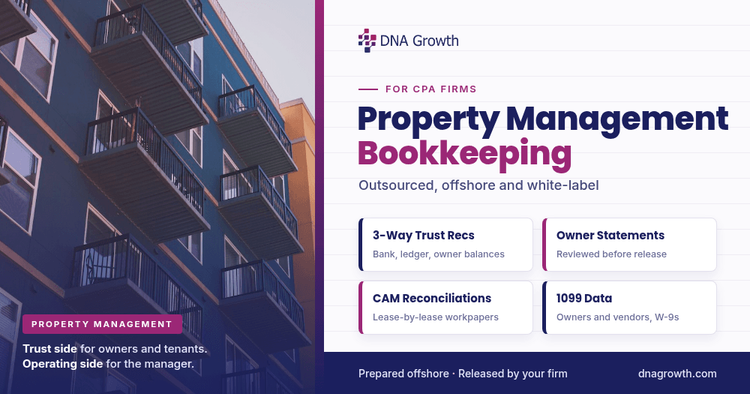
Property management clients look simple until you take one on. Every rent payment belongs to someone else, every owner expects a clean statement on the same day each month, and a single trust account error can put the manager's license at risk. For CPA firms, that mix of volume and compliance is hard to staff. This guide covers what the work includes, where it usually breaks, and how firms hand the routine parts to an offshore team.
What does property management bookkeeping include?
Property management bookkeeping covers the money a manager handles for owners and tenants as well as the manager's own books. In practice, it includes rent and deposit recording, trust account reconciliations, owner statements and distributions, vendor bills, CAM reconciliations for commercial tenants, and year-end 1099s. Most of it runs on a fixed monthly cycle, with CAM and 1099s concentrated in the first quarter.
The table below works as a checklist for scoping a new client.
| Task | What it involves | How often |
|---|---|---|
| Rent and receipts | Posting rent, fees, and other income to the right tenant, unit, and owner ledger | Daily or weekly |
| Trust account reconciliation | Matching the bank balance, the trust ledger, and the total of owner ledgers | Monthly at minimum |
| Security deposit tracking | Recording deposits held, moved, applied to damages, or returned by tenant | Ongoing, checked monthly |
| Owner statements | Income, expenses, reserves, and net due to each owner for the period | Monthly |
| Owner distributions | Paying out owner balances after reserves and pending bills | Monthly |
| Vendor bills and AP | Coding maintenance and service invoices to the right property and owner | Weekly |
| Management fees | Calculating and moving the manager's fee from trust to operating | Monthly |
| CAM reconciliation | Comparing estimated CAM billed to commercial tenants against actual costs | Annually, sometimes quarterly |
| 1099 reporting | 1099-MISC to owners for rents collected, 1099-NEC to service vendors | Annually, by January 31 |
| Manager's operating books | The management company's own income, payroll and expenses, kept separate from trust | Monthly |
The last row matters more than it looks. A property management client is really two sets of books: the trust side, which belongs to owners and tenants, and the operating side, which belongs to the manager. Keeping those apart is the foundation of everything else.
Trust accounting: the part regulators actually check
In most states, a property manager collecting rent for others does so under a real estate broker license, and that money must sit in a trust account. Owners and tenants are the beneficiaries. The manager is only holding it.
The standard test is a three-way reconciliation. Three numbers have to agree at the same date:
- The reconciled balance of the trust bank account
- The balance of the trust ledger in the property management software
- The total of every individual owner's ledger balance
If the bank and the ledger agree but the owner's balances don't add up, money has been posted to the wrong owner. That error is invisible on a two-way rec and only shows up when an owner complains.
Rules differ by state, so check the client's licensing regulator. California is a useful benchmark because its Department of Real Estate publishes the violations it finds most often in audits. Its rules require:
- a running record of all trust funds received and paid out, with a daily balance
- a separate record for each beneficiary or transaction
- a reconciliation of those separate records to the overall trust record at least once a month, under Regulation 2831.2
- trust funds deposited within three business days of receipt
- no more than $200 of the broker's own money left in the trust account, to avoid commingling
- written consent from every owner before any payment that would push the account below what is owed to them
Security deposits sit inside this. Some states require deposits to be held in a separate account, some require interest to be paid to tenants, and most set a deadline for returning the deposit with an itemized statement after move-out. Your bookkeeping needs to show, tenant by tenant, how much is held, where it is and what happened to it.
The common failure points are predictable: a deposit recorded as income, an owner paid before a vendor bill clears, a management fee pulled before rent posts, or a negative owner balance quietly covered by other owners' money. A monthly three-way rec catches all of them.
Owner statements: the report your client is judged on
Owners rarely see the trust rec. They see the owner's statement, and they judge the property manager on it. A late or confusing statement brings phone calls even when every number is right.
A reliable monthly cycle tends to look like this:
Days 1 to 5. Rent is posted as it arrives. Late fees go on per the lease, and failed payments are reversed and flagged.
Days 5 to 10. Vendor bills for the month are entered and coded to the property, and to the unit where it matters. Anything over an owner's approval limit is held for sign-off.
Around day 10. The trust account is reconciled three ways for the prior month. Statements are not released until it ties.
Days 10 to 15. Management fees are calculated and moved. Owner statements are generated, reviewed for anything unusual, such as a negative balance, a large repair or a vacancy, and sent.
Distribution day. Owner balances are paid out after holding back the agreed reserve and any bills still pending.
The review step is where an experienced eye earns its fee. Software can produce a statement in seconds. It won't notice that a roof repair was coded to the wrong building, or that an owner's reserve has dropped below what the agreement requires. Those catches are what keep owners with your client, and keep your client with you.
For managers who also handle HOA or association accounts, the same discipline applies with a board instead of an owner reading the report.
CAM reconciliations: once a year, and easy to get wrong
Commercial tenants on net leases usually pay estimated common area maintenance charges each month. Once the year closes, the landlord compares those estimates with what was actually spent and bills or credits each tenant the difference. That true-up is the CAM reconciliation.
Leases set the deadline, and many give the landlord around 90 to 120 days after year end to deliver the statement. For a calendar-year portfolio, that puts the work in the same weeks as 1099s and tax season. It's one of the main reasons firms with commercial property clients feel stretched in the first quarter.
The math itself is simple. The hard part is applying each lease correctly, because every lease can treat the same cost differently.
- Pro rata share. The tenant's share is usually its square footage over the building's, but leases differ on whether the denominator is total or leased area.
- Gross-up. Many leases adjust variable costs as if the building were, say, 95% occupied, so tenants don't pay more because of vacancies.
- Exclusions. Capital improvements, debt service, leasing commissions and costs billed directly to one tenant are commonly excluded.
- Caps. Controllable expenses may be capped at a fixed annual increase, and the cap may compound or not.
- Admin and management fees. Often limited to a percentage of CAM or of gross revenue.
- Base year or expense stop. Some tenants only pay increases over a base year.
Tenants often have audit rights that run for a year or two after they receive the statement. A reconciliation that can't be traced back to invoices and lease terms is a refund waiting to happen. Build a CAM workpaper for each property that lists every lease's terms next to the calculation, so anyone reviewing it can follow the logic.
1099s: what changes for the 2026 tax year
A property manager often files 1099s from two directions. Owners receive a 1099-MISC for the rents the manager collected on their behalf, reported as rents. Service vendors, such as contractors, landscapers and cleaners, receive a 1099-NEC for what they were paid.
The filing threshold has moved. Under the One Big Beautiful Bill Act, the reporting threshold for most 1099-MISC and 1099-NEC payments rises from $600 to $2,000 for payments made after December 31, 2025, with inflation indexing to follow. So the forms your clients file in January 2027, covering 2026, use the new $2,000 threshold. Rents are among the payments covered.
A few points still catch people out:
- Attorneys. Gross proceeds paid to an attorney still use a $600 threshold in Box 10 of the 1099-MISC, per the IRS draft 2026 instructions.
- Backup withholding. If a vendor never provided a valid W-9, payments may be subject to 24% backup withholding and reportable regardless of the threshold. Collect W-9s when a vendor is set up, not in January.
- Card and app payments. Payments made by card or through a payment platform are generally reported by the processor on a 1099-K, not by your client. The 1099-K threshold is back to more than $20,000 and more than 200 transactions.
- Owner records. Owner names, tax IDs, and addresses change with sales and transfers during the year. Clean them up in the fourth quarter.
With the higher threshold, fewer small vendors will need forms. That makes the vendor list review more important, not less, since someone still has to check who crossed $2,000 across every property they serviced.
Splitting the work between your firm and an offshore team
Most of the hours in property management accounting go into posting, coding, reconciling, and preparing reports. Clients pay for, and regulators look at, a much smaller set of judgment calls. That split is what makes the work well-suited to outsourced property management bookkeeping, provided the line between the two is drawn clearly.
| Offshore team prepares | Your firm reviews or owns |
|---|---|
| Rent, fee and receipt posting | Client relationship and owner escalations |
| Vendor bill entry and coding by property | Approval of unusual or large expenses |
| Monthly three-way trust reconciliations | Sign-off on the rec before statements go out |
| Security deposit ledgers | Disputes over deposit deductions |
| Draft owner statements and distribution lists | Release of distributions and any payments from trust |
| CAM workpapers and draft true-up statements | Lease interpretation calls and the final CAM sign-off |
| 1099 vendor and owner data review, W-9 follow-up | Filing decisions and the client conversation |
| Manager's operating books and month-end close | Tax planning and advisory |
A few practical points help this work well.
Work inside the client's software. Property managers run on platforms like AppFolio, Buildium, Yardi, Rent Manager and Propertyware. A good offshore team works directly in those systems rather than exporting to spreadsheets, which keeps the audit trail in one place.
Keep trust access tight. The team should be able to prepare and reconcile, but not release money from a trust account. Payments from trust are approved and released by your firm or the client.
Write a playbook per client. Owner approval limits, reserve rules, fee calculations, late fee policy and the state's trust rules all differ. A page or two per client stops the same questions coming back every month.
Keep your name on it. With white label bookkeeping for property management, the offshore team works under your firm's process and brand. Owners and managers keep dealing with you.
Whether you call it virtual or offshore, the model works when the property management accountant on your side spends their time reviewing and advising, not posting rent.
Getting started, and where DNA Growth fits
The safest way to move property management work offshore is one client at a time, starting with the cleanest.
- Pick a client with a tidy trust account. Fix any old reconciliation gaps before the handover, not during it.
- Document the cycle. Write down posting cutoffs, statement dates, approval limits, fee rules, and distribution day.
- Run one month in parallel. The offshore team prepares the rec and statements, and your staff prepares them too. Compare the two before anything goes to the owners.
- Move review to sign-off. Once two months tie cleanly, your team reviews and releases instead of preparing.
- Plan for the first quarter. Agree early who prepares CAM workpapers and 1099 data, so January and February aren't a scramble.
DNA Growth provides offshore bookkeeping teams for CPA firms, working white-label in the property management platforms your clients already use. Our team handles posting, trust reconciliations, owner statement prep, CAM workpapers, and 1099 data. Your firm keeps the client relationship, the approvals, and every payment out of trust.
If you're scoping a first handover, our Offshore Bookkeeping Setup Kit walks through access, documentation, and the parallel-run checklist step by step.
Head of Finance & Operations, DNA Growth
Ishpreet Kaur (IP) is Head of Finance & Operations at DNA Growth. With 10 years in FP&A at Deloitte and Thomson Reuters, she turns financial planning into a competitive advantage — helping clients gain real visibility and precision in their financial strategy.
Related Content You Might Like
 Accounting and Bookkeeping
Rental Property Bookkeeping at Scale: 100+ Landlord Clients
Accounting and BookkeepingHire Offshore AP and AR Specialists: Lower DSO and Processing Costs
Accounting and BookkeepingOffshore Accounting Automation and RPA: Bank Recs, AP Routing and the M
Turn Finance Into a Growth Engine
Join 1,200+ companies that rely on DNA Growth for outsourced CFO, FP&A, and accounting support.